
The rules for baby passport photos (with the one big exception)
Reviewed July 2026, based on U.S. Department of State guidance. A baby's passport photo follows the same specification as an adult's — with one merciful exception written into the rules:
| Rule | Requirement for infants |
|---|---|
| Size | 2 × 2 in print; head 1–1⅜ in chin-to-crown; square 600–1200 px digital |
| Background | Plain white or off-white — a smooth white sheet qualifies |
| Eyes | Newborns/infants may have eyes partially or fully closed — the only age group with this exemption. Older children: eyes open. |
| Who's in the frame | The baby only. No parent hands, arms or laps visible. |
| Props | No pacifiers, bottles, toys, headbands or hats |
| Expression | Officials are lenient with infants — calm beats perfect |
| Recency | Taken within 6 months of applying; valid for the passport's full 5 years |
One more rule parents are often surprised by: every child needs their own passport from birth — infants can't travel on a parent's document. Under-16 passports are valid 5 years and require an in-person DS-11 application with both parents consenting.
The white-sheet method, step by step
This is the technique the State Department itself suggests for babies who can't yet hold their head up — and it doubles as the easiest setup for any infant:
- Timing first: right after a nap and a feed is the golden window. A content baby buys you two or three calm minutes — that's all you need.
- Set the stage: spread a white sheet flat on the floor or a firm bed near a big window. Smooth out wrinkles; strong creases cast the shadows that get photos flagged.
- Position your baby on their back, head centered, facing straight up. For a baby who hates lying flat, buckle them into a car seat draped completely with a white blanket instead.
- Shoot from directly above: phone parallel to the floor, 2–3 feet up, baby's face filling the middle of the frame. Daylight only — flash creates harsh shadows and red eyes.
- Use burst mode. Ten frames in three seconds beats posing. You're hunting for one frame with a neutral-ish face; for newborns even closed eyes are acceptable.
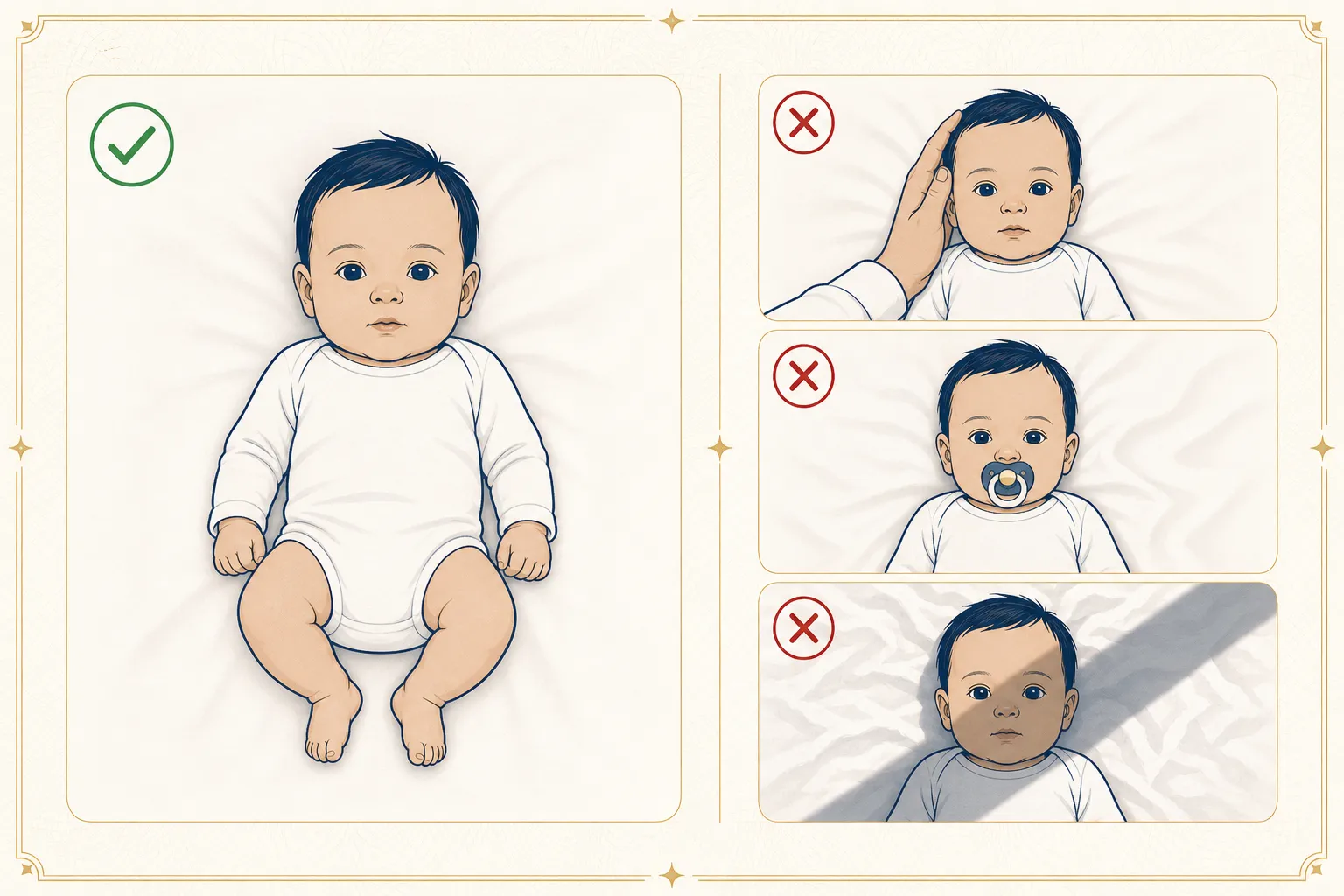
Why babies fail the photo check (and how each one is avoidable)
- A visible hand. The most common infant rejection. Support the head from under the sheet or blanket if needed — fabric hides everything.
- Shadow across the face or sheet. Move away from direct sun; sideways window light plus a white sheet gives soft, even illumination.
- Something in the mouth. Pacifier out, even mid-cry — a crying newborn photo is more acceptable than a pacified one.
- Another person in frame. Crop can't always save a photo taken on a parent's lap; the sheet method avoids the problem entirely.
- Head tilted or turned. Center their gaze with a toy held next to (not instead of) the camera.
Skip the pharmacy trip — this is the part built for parents
Here's the honest math on taking an infant to a retail photo counter: pack the diaper bag, drive, wait in line, hope the baby stays calm precisely when a stranger points a camera at them under fluorescent lights — then pay $14.99–$17.99. If the shot isn't compliant, do it all again.
The at-home workflow inverts every one of those problems. You shoot in your baby's calmest five minutes, retake for free as many times as needed, and the AI does the studio's job: it replaces the sheet with a regulation white background, evens out the window light, and applies the official head-size crop — with a free preview before you pay $2.99. The download includes the digital file (required for online applications) plus a print-ready sheet you can print at Walgreens, CVS or Walmart for under a dollar.
The same method works for every document a child might need: the U.S. passport photo maker for DS-11 applications, the U.S. visa maker for dependent visas, the green card maker for I-485 family filings, or the China and India visa makers for family trips — each preset applies its own country's infant-tolerant composition rules.